

 or https:// as an added precaution.


















Rules of Taekwondo
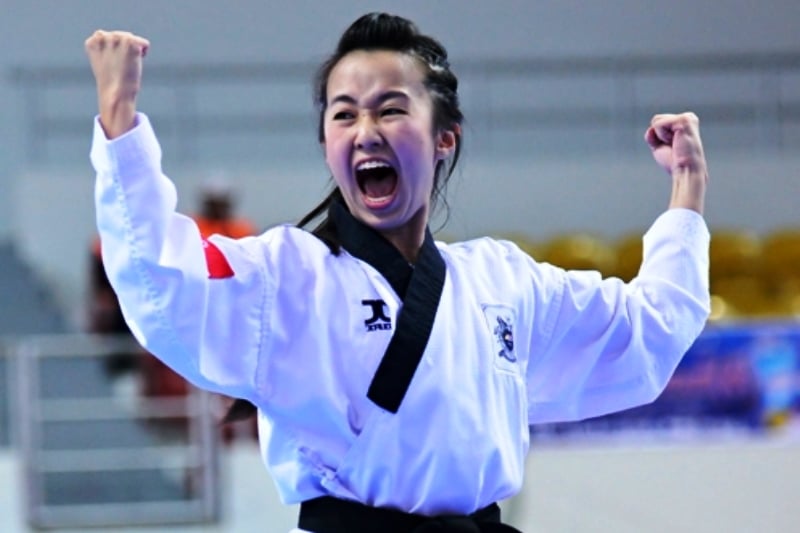
Image credit: Andrew Tan/SportSG
A combination of combat and self-defence, taekwondo can be slightly confusing for a beginner. Here are some of the basic rules that govern a taekwondo bout.
Scoring
The main objective of this sport is to land as many kicks and hits on your opponent during the competition. Each competition comprises of three rounds lasting two minutes, with one minute breaks between each round. The competitor that manages to score the most from these three rounds is automatically named the winner.
Each target area on the body will earn you a different amount of points. A point is only awarded when two or more judges registers a Taekwondo Movements Sparring. For instance, landing a kick or blow to an opponent’s chest is worth one point, while a kick to the head or neck is worth two points. Kicks are also only awarded points if the impact is made via an area below the ankle. All blows must be below the head.
Additionally, if a competitor manages to knock his opponent down, he earns three points. This refers to the act of putting the opponent on the ground, so that any part of his body except the feet is touching the playing area.
Penalties
Participants are not allowed to step outside the boundary line, nor can they push, grab or hold an opponent. Other moves that will earn them a penalty include feigning injury as well as turning one’s back towards the opponent.
More severe penalties include attacking the opponent’s head with anything but the feet, throwing an opponent, stepping over the boundary line and deliberately pulling the opponent down to the ground.
Winning
At the end of the three rounds, the participant with the most number of points is declared the winner. However, unlike other sports, a draw in points in taekwondo does not always require an additional round to determine the winner, although it is possible. A golden point round will be organised, and the first player to score a point in this round will be named the winner.
Another way of determining the winner is to take the points that each player scored before any penalty deductions were made. The player with the highest number of points wins. If this, too, is not an option, the referee will declare the player based on who has shown more willingness to attack during the game.
A competitor can also win if he manages to knock out his opponent. This involves causing his opponent to fall to the ground, such as knocking him down. The opponent has to be on the ground for more than 10 seconds before it will be considered a knockout.
Keen to start your Taekwondo journey? Check out Visit myactivesg.com for our latest classes and workshops!
To receive the latest updates on the happenings in the Singapore sports scene, or to find out more about some of the latest programmes on offer at ActiveSG, like our Facebook page Visit our Facebook Page.