screen reader
Active Health In The Community
Active Health brings fitness and wellbeing closer to where we live, work, and play—making a healthier and sporting lifestyle accessible for everyone, at every stage of life.
Through two key engagement modes — the Active Health Community Fitness Challenge (AHrena), built on five core fitness components, and the Active Health Mobility Assessment Programme (MAP), which blends mobility assessments with simple corrective exercises — we empower individuals to take ownership of their health and make informed, lasting lifestyle changes.
According to the Singapore Physical Activity Guidelines (SPAG), adults and seniors are encouraged to engage in 150–300 minutes of moderate-intensity aerobic activity weekly, along with muscle-strengthening exercises at least twice a week.
*Note: The AHrena challenges are designed with your safety in mind and is recommended for those aged 13 and above. Alternative modalities are available for younger children and seniors so everyone can join in the fun!
Are you ready to get started with us?
Step into the AHrena
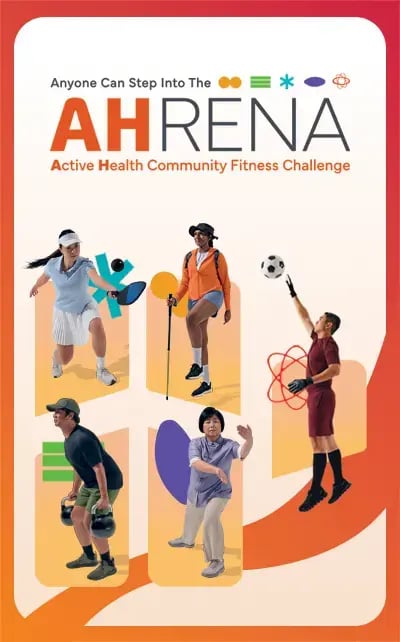
AHrena, a blend of “Active Health” (AH) and “arena”, is an inspiring fitness challenge that empowers everyone to discover their potential through science-backed, fun, and educational activities.
Staying active isn’t just for athletes—anyone can rediscover the joy of moving their body, build confidence, and enjoy a vibrant, fulfilling life.
The Active Health Community Fitness Challenge (AHrena) is a gateway to discovering your potential through a series of engaging and educational fitness activities across five core components designed to inspire and empower you:
Cardiovascular Fitness: Essential for overall heart health and endurance.
Muscular Strength: Crucial for maintaining independence and performing everyday tasks with ease.
Balance: Important for preventing falls and enhancing coordination.
Agility: Enhances quick and efficient movement, beneficial in various sports and daily activities.
Muscular Power: Vital for explosive movements and overall physical performance.
-
CARDIO
-
STRENGTH
-
BALANCE
-
AGILITY
-
POWER
What is it?
Cardiovascular fitness is the ability of the circulatory system to deliver the oxygen muscles need.
Why is it important?
Good cardiovascular fitness enhances overall exercise capabilities and sustains physical activity longer without experiencing fatigue.
Relating back to daily activities:
• Sports: Improves sport performance.
• Daily activities: Eases tasks like household chores.
*SPAG: Perform 150-300 minutes of moderate-vigorous aerobic physical activity per week for optimal heart health.
*SPAG (Singapore Physical Activity Guidelines)
Cardio Exercises in Action
What is it?
Muscular strength is the ability of muscles to exert force against resistance.
Why is it important?
Critical for daily functional activities and combating muscle loss with age (sarcopenia).
Relating back to daily activities:
• Sports: Enhances lifting capabilities.
• Daily activities: Aids in lifting and moving objects.
*SPAG: Perform resistance exercises targeting major muscle groups at least 2 days a week at moderate or vigorous intensity for stronger muscles, bones, and joints.
*SPAG (Singapore Physical Activity Guidelines)
Muscular Strength Exercises in Action
What is it?
Balance is the ability to control body movement in an upright position.
Why is it important?
Crucial for daily activities and reducing fall risks.
Relating back to daily activities:
• Sports: Improves stability in dynamic sports.
• Daily activities: Maintains balance during movement.
*SPAG: Individuals over 50 years should engage in functional balance-focused activities at least 3 days a week at moderate or greater intensity.
*SPAG (Singapore Physical Activity Guidelines)
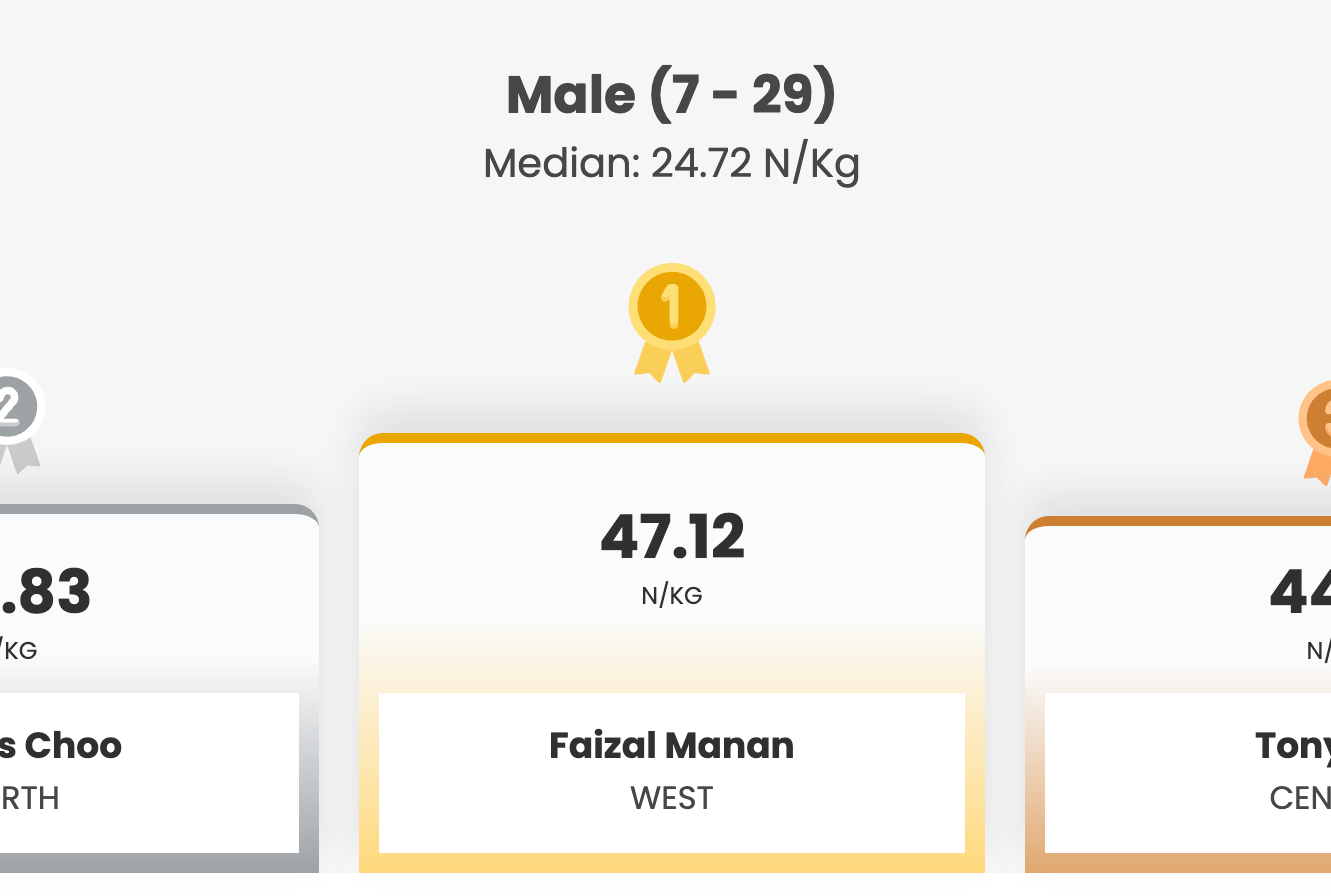
Average Score Board
Scores are currently unavailable as this is a new activity. Stay tuned for future updates!
Balance Exercises in Action
What is it?
Agility allows quick, controlled movement changes in response to stimuli.
Why is it important?
Enables swift and precise movements, essential in sports and daily life.
Relating back to daily activities:
• Sports: Swift direction changes in competitive settings.
• Daily activities: Manoeuvring through crowded spaces.
*SPAG: Include varied multicomponent activities to enhance agility and movement flexibility.
*SPAG (Singapore Physical Activity Guidelines)
Agility Exercises in Action
What is it?
Muscular power is the ability to apply maximum force as quickly as possible.
Why is it important?
Enhances athletic performance and reduces injury risks.
Relating back to daily activities:
• Sports: Executing explosive moves like jumps.
• Daily activities: Picking up walking pace when required and making swift movements to avoid obstacles.
*SPAG: Incorporate diverse activities or sports to boost muscular power and overall performance.
*SPAG (Singapore Physical Activity Guidelines)
Muscular Power Exercises in Action
Active Health MAP:
Assess, Strengthen, Move Better
Discover your body's movement potential with Active Health MAP (Mobility Assessment Programme), an innovative, evidence-based approach to understanding and improving how you move your body.
Designed to bring the community together, Active Health MAP assesses and enhances your mobility, stability, and functional movement patterns through fun, interactive activities in a 30-minute session perfect for everyone!
Active Health MAP (Mobility Assessment Programme) features three core components designed to assess and enhance how your body moves:
Mobility: Improves your joints’ ability to move freely and efficiently — essential for daily movement and injury prevention.
Stability: Strengthens your control and balance, helping you stay steady during both simple and complex movements.
Functional Movement Patterns: Evaluates how well your body performs basic movement sequences like bending, twisting, and reaching — the foundation for both sports and daily life.
General Population
- Hip & Spine
- Shoulder
- Hip and Lower Body
- Upper Body
- Ankle
What is it?
Bend and Reach assesses hip and spine mobility through bending and extending movements.
Why is it important?
Good hip and spine mobility improves posture, reduces back pain risk, and enhances movement fluidity for daily life and sports.
Daily relevance:
• Sports: Gymnastics, dance, weightlifting, martial arts
• Daily: Bending to pick up items, standing with proper form
How to do it:
• Bend down to reach for the floor.
• Extend your back, reach for the sky and exhale at the top.
• Repeat as needed.
Corrective Exercise
Can't manage the assessment exercise yet? Start with this correction exercise to build up!
Resistance Band Deadlifts
Programmes to Help You Move Better
Build Mobility, Stability & Strength
Explore Active Health MAP programmes designed to improve how you move—enhancing joint mobility, balance, and everyday functional movement.
What is it?
Shoulder mobility exercises improve your shoulder’s flexibility and range of motion.
Why is it important?
They enable strong, efficient overhead movements and help prevent injuries.
Daily relevance:
• Sports: Water polo, basketball, volleyball, javelin, baseball
• Daily: Reaching, lifting, pulling
How to do it:
• Stand with feet shoulder-width apart.
• Use your right fingertips to hold your left earlobe.
• Move your right arm around your head and toward your back, keeping your head upright.
• Avoid tilting the head while rotating the arm.
Corrective Exercise
Can't manage the assessment exercise yet? Start with this correction exercise to build up!
Resistance Band Shoulder Floss
Programmes to Help You Move Better
Build Mobility, Stability & Strength
Explore Active Health MAP programmes designed to improve how you move—enhancing joint mobility, balance, and everyday functional movement.
What is it?
Hip abduction improves your hip and lower body mobility and balance.
Why is it important?
Good hip and lower body mobility helps you to move your lower limbs with ease, control and balance.
Daily relevance:
• Sports: Running, cycling, soccer, hurdling, sepak takraw
• Daily: Walking, climbing stairs
How to do it:
• Stand with feet hip-width apart.
• Balance on one leg and lift your other knee up and over to the other side.
• Avoid moving your body as you rotate your leg outwards to the side.
• Return to starting position and repeat.
Corrective Exercise
Can't manage the assessment exercise yet? Start with this correction exercise to build up!
Resistance Band Split Squat
Programmes to Help You Move Better
Build Mobility, Stability & Strength
Explore Active Health MAP programmes designed to improve how you move—enhancing joint mobility, balance, and everyday functional movement.
What is it?
Thoracic spine mobility is the ability to rotate and move your mid-back freely.
Why is it important?
It improves posture, supports spinal health, and eases strain on your back and neck.
Daily relevance:
• Sports: Golf, tennis, swimming
• Daily: Helps with twisting motions like checking blind spots, putting on seatbelts, passing food around the table.
How to do it:
• Rotate torso side to side, in a smooth and controlled manner.
• Keep shoulders and head turning together.
• Toes and feet remain pointing forward.
Corrective Exercise
Can't manage the assessment exercise yet? Start with this correction exercise to build up!
Resistance Band Thoracic Rotation
Programmes to Help You Move Better
Build Mobility, Stability & Strength
Explore Active Health MAP programmes designed to improve how you move—enhancing joint mobility, balance, and everyday functional movement.
What is it?
This assessment looks at your ankle's ability to be in a dorsiflexed position.
Why is it important?
Good ankle mobility improves balance, reduces ankle and knee injuries as well as helps us move better in our day-to-day activities.
Daily relevance:
• Sports: Fencing, weightlifting, martial arts
• Daily: Deep squats, balancing on the train, walking and climbing stairs.
How to do it:
• Stand with one leg forward, one leg back.
• Keep both heels on the ground and lean body forward.
• Toes remain pointing forward.
• Return to starting position and repeat.
Corrective Exercise
Feeling like you can't go very far back? Start with this correction exercise to build up!
Resistance Band Single Leg Calf Raise
Programmes to Help You Move Better
Build Mobility, Stability & Strength
Explore Active Health MAP programmes designed to improve how you move—enhancing joint mobility, balance, and everyday functional movement.
Seniors
- Upper Back
- Shoulder Blade
- Hip & Spine
- Ankle
- Lower Limb
What is it?
Thoracic spine mobility is the ability to rotate and move your mid-back freely.
Why is it important?
It improves posture, supports spinal health, and eases strain on your back and neck.
Daily relevance:
Helps with twisting motions like checking blind spots, putting on seatbelts, passing food around the table.
How to do it:
• Sit upright on the front half of the chair.
• Rotate torso side to side, in a smooth and controlled manner.
• Keep shoulders and head turning together.
Corrective Exercise
Can't manage the assessment exercise yet? Start with this correction exercise to build up!
Seated Banded Thoracic Rotation
Programmes to Help You Move Better
Build Mobility, Stability & Strength
Explore Active Health MAP programmes designed to improve how you move—enhancing joint mobility, balance, and everyday functional movement.
What is it?
Shoulder mobility exercises improve your shoulder’s flexibility and range of movement.
Why is it important?
They enable strong, efficient overhead movements and help prevent injuries.
Daily relevance:
Reaching, lifting, pulling.
How to do it:
• Work in pairs, taking turns.
• Sit with feet shoulder-width apart.
• Use your right fingertips to hold your left earlobe.
• Move your right arm around your head and toward your back, keeping your head upright.
• Avoid tilting the head while rotating the arm.
Corrective Exercise
Can't manage the assessment exercise yet? Start with this correction exercise to build up!
Seated Shoulder Floss
Programmes to Help You Move Better
Build Mobility, Stability & Strength
Explore Active Health MAP programmes designed to improve how you move—enhancing joint mobility, balance, and everyday functional movement.
What is it?
Bend and Reach assesses hip and spine mobility through bending and extending seated movements.
Why is it important?
Good hip and spine mobility improves posture, reduces back pain risk, and enhances movement fluidity for day-to-day activities
Daily relevance:
Bending to pick up items, standing with proper form, doing housework.
How to do it:
•Sit on the front half of the chair, feet wider than shoulder width apart.
• Bend down to reach for the floor.
• Extend your back, reach for the sky and exhale at the top.
Corrective Exercise
Can't manage the assessment exercise yet? Start with this correction exercise to build up!
Seated Banded Deadlifts
Programmes to Help You Move Better
Build Mobility, Stability & Strength
Explore Active Health MAP programmes designed to improve how you move—enhancing joint mobility, balance, and everyday functional movement.
What is it?
This assessment looks at your ankle's ability to be in a dorsiflexed position with a seated version of the assessment.
Why is it important?
Good ankle mobility improves balance, reduces ankle and knee injuries as well as helps us move better in our day-to-day activities.
Daily relevance:
Deep squats, balancing on the train, walking and climbing stairs.
How to do it:
• Sit on the front half of the chair with both feet firmly on the floor.
• Push your right heel back as far as you can without lifting your heels off.
• Make sure to keep your heels on the floor.
• Return to starting position and repeat.
Corrective Exercise
Can't manage the assessment exercise yet? Start with this correction exercise to build up!
Seated Banded Calf Dorsiflexion
Programmes to Help You Move Better
Build Mobility, Stability & Strength
Explore Active Health MAP programmes designed to improve how you move—enhancing joint mobility, balance, and everyday functional movement.
What is it?
Sit to stand assesses lower body strength and your ability to stand from a seated position with ease and without assistance.
Why is it important?
Lower body strength is the foundation of daily movement, it helps to stabilise and support our joints.
Daily relevance:
Sitting to standing, walking on uneven surfaces, climbing stairs, gardening.
How to do it:
• Sit on the front half of the chair, feet shoulder width apart, arms across your chest.
• Stand up straight before sitting back down again. Repeat.
• Keep your back straight.
Corrective Exercise
Can't manage the assessment exercise yet? Start with this correction exercise to build up!
Banded Sit to Stands
Programmes to Help You Move Better
Build Mobility, Stability & Strength
Explore Active Health MAP programmes designed to improve how you move—enhancing joint mobility, balance, and everyday functional movement.
Parent & Child
- Upper Back
- Hip
- Hip & Spine
- Ankle
What is it?
Thoracic spine mobility is the ability to rotate and move your mid-back freely.
Why is it important?
It improves posture, supports spinal health, and eases strain on your back and neck.
Daily relevance:
• Sports: Boosts rotation in tennis, swimming, and golf.
• Daily: Helps with twisting motions like checking blind spots.
How to do it:
• Stand back-to-back with a partner.
• Rotate torso side to side, passing a ball each turn.
• Keep shoulders and head turning together.
Corrective Exercise
Can't manage the assessment exercise yet? Start with this correction exercise to build up!
Woodchops
Programmes to Help You Move Better
Build Mobility, Stability & Strength
Explore Active Health MAP programmes designed to improve how you move—enhancing joint mobility, balance, and everyday functional movement.
What is it?
Ball Juggling assesses balance and hip by challenging lower body control and coordination.
Why is it important?
Good hip mobility and balance enhance agility, prevent injuries, and support smooth movements in sports and daily life.
Daily relevance:
• Sports: Football, soccer, and sports needing quick knee lifts and balance
• Daily: Walking on uneven surfaces, maintaining stability
How to do it:
• Take turns with a partner.
• Partner drops the ball in front of the child.
• Child taps the ball repeatedly with their knee, counting taps.
• Switch legs and repeat.
Corrective Exercise
Can't manage the assessment exercise yet? Start with this correction exercise to build up!
DROP-TAP-CATCH
Programmes to Help You Move Better
Build Mobility, Stability & Strength
Explore Active Health MAP programmes designed to improve how you move—enhancing joint mobility, balance, and everyday functional movement.
What is it?
Reach and Bend is a partner exercise that assesses hip and spine mobility through bending and extending movements.
Why is it important?
Good hip and spine mobility improves posture, reduces back pain risk, and enhances movement fluidity for daily life and sports.
Daily relevance:
• Sports: Gymnastics, dance, weightlifting, martial arts
• Daily: Bending to pick up items, standing with proper form
How to do it:
• Stand back-to-back with a partner.
• Bend down and pass a ball between your legs.
• Extend your back and exhale at the top.
• Repeat as needed.
Corrective Exercise
Can't manage the assessment exercise yet? Start with this correction exercise to build up!
Hamstring Stretch
Programmes to Help You Move Better
Build Mobility, Stability & Strength
Explore Active Health MAP programmes designed to improve how you move—enhancing joint mobility, balance, and everyday functional movement.
What is it?
This Fencing Drill focuses on assessing the ankle at the back on your ability to be in a dorsiflexed position through a fun ball drill.
Why is it important?
Good ankle mobility is essential in helping us reduce injuries and ensures proper squat mechanics in our day-to-day movements.
Daily relevance:
• Sports: Fencing, badminton, weightlifting.
• Daily: Sitting to standing, deep squats, driving.
How to do it:
• Stand facing a partner, one arm's length away.
• Partner holds out the ball in front of them.
• Child lunges forward without lifting the back foot to try to tap the ball.
• Return to starting position and repeat.
Corrective Exercise
Can't manage the assessment exercise yet? Start with this correction exercise to build up!
Calf Raise To Toss
Programmes to Help You Move Better
Build Mobility, Stability & Strength
Explore Active Health MAP programmes designed to improve how you move—enhancing joint mobility, balance, and everyday functional movement.
Move Safe. Stay Strong. Be Inspired.
This challenge is designed with your safety in mind and is recommended for those aged 13 and above. Not to worry—alternative activities are available for younger children and seniors so everyone can join in the fun.
At Active Health, we believe that small everyday habits can make a big difference to your well-being.
Launched in 2017 under Sport Singapore’s Sport Development Group, our initiative supports you in building healthier lifestyles through movement, nutrition, rest, and mental wellness. Whether you're trying to move more, eat better, or sleep well, our holistic approach—and our friendly, sport science-trained Active Health Coaches—are here to guide you every step of the way across our islandwide Active Health Labs.
According to the Singapore Physical Activity Guidelines (SPAG), adults and seniors are encouraged to engage in 150–300 minutes of moderate-intensity aerobic activity weekly, along with muscle-strengthening exercises at least twice a week.
*Note: The AHrena challenges are designed with your safety in mind and is recommended for those aged 13 and above. Alternative modalities are available for younger children and seniors so everyone can join in the fun!
Follow us on Facebook and Instagram to stay updated and share your journey!