or https:// as an added precaution.






![ActiveSG Academies and Clubs Logo (Solid Colour)[8647]](https://www.activesgcircle.gov.sg/hs-fs/hubfs/ActiveSG%20Circle%202023Theme/images/ActiveSG%20Academies%20and%20Clubs%20Logo%20(Solid%20Colour)%5B8647%5D.png?width=150&height=65&name=ActiveSG%20Academies%20and%20Clubs%20Logo%20(Solid%20Colour)%5B8647%5D.png)





-01.png?width=200&height=141&name=Team%20Singapore%20Logo%20(Red)-01.png)





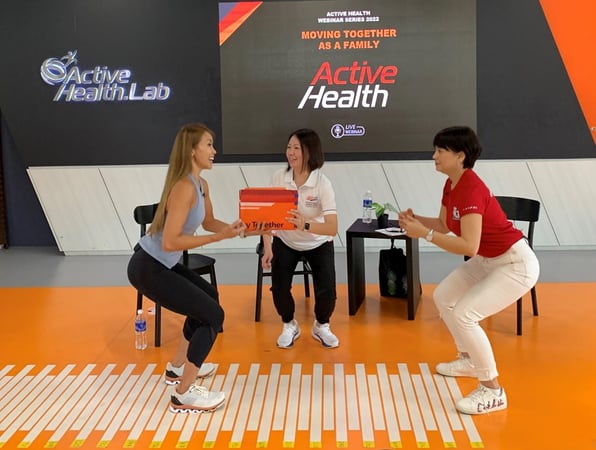



When entrepreneur and SportSG Ambassador Ms Dawn Sim conducts yoga classes from home, she sometimes has a little helper: her youngest daughter.
“I’ll be teaching and she’ll just roll her mat out, and she’ll be demonstrating by the side,” said the mother of four. “It’s heartwarming for me to see that. We talk a lot about how we can encourage our children to be active, right? I think it starts from the parents.”
When it comes to getting children involved and interested in keeping active, parents have to walk the talk. But that hasn’t quite been the case, as Dr Elaine Chew shared.
The head and senior consultant for the Adolescent Medicine Service Department at the KK Women’s and Children’s Hospital said that 60 percent of children in Singapore do not meet recommended physical activity guidelines.
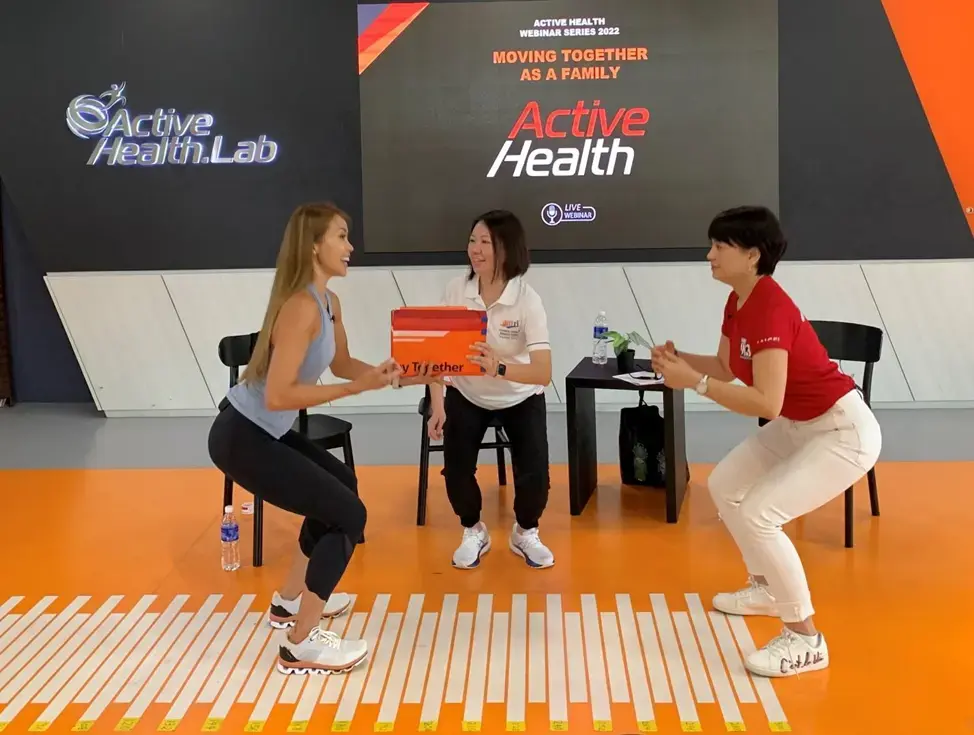
In the second of a series of Make Every Move Count webinars organised by Active Health, Ms Sim and Dr Chew, discussed the challenges of - as well as shared tips to - helping children meet Singapore Physical Activity Guidelines (SPAG) amid the stress of studies and a rise in screen time.
Children are now using electronic devices from a younger age, and parents worry that their kids being glued to their screens could lead to living a more sedentary, less active lifestyle. It is parents, said the two speakers, who will have to set the rules when it comes to screen time, and find ways to get children away from their screens.
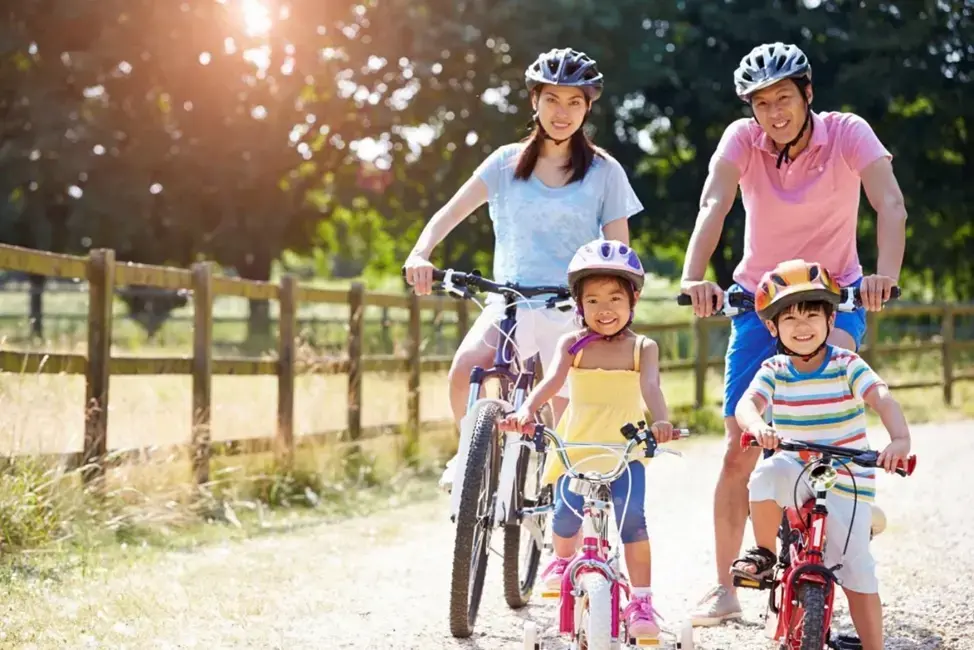
Healthy habits start at home, so parents are their children’s most important coaches. They have a big part to play in getting their children up and moving. But that can start with the smallest of steps, such as involving their kids in their own exercise routines.
Ms Sim, the founder of yoga studio Trium Fitness, said that many times her students draw a line between exercise time and time with their kids: Work out first, and then spend time with their children after.
“Exercise can be something that you do with your family, instead of perhaps watching and waiting at the sidelines for your child to complete their sport,” said Ms Sim. “I think it’s important for us to create opportunities to do things together, and to make it something that the children look forward to doing together.”
The importance of parent-child activities was echoed by Dr Chew, who shared key recommendations of the Singapore Integrated 24-Hour Activity Guidelines for Early Childhood which are aligned with SPAG.
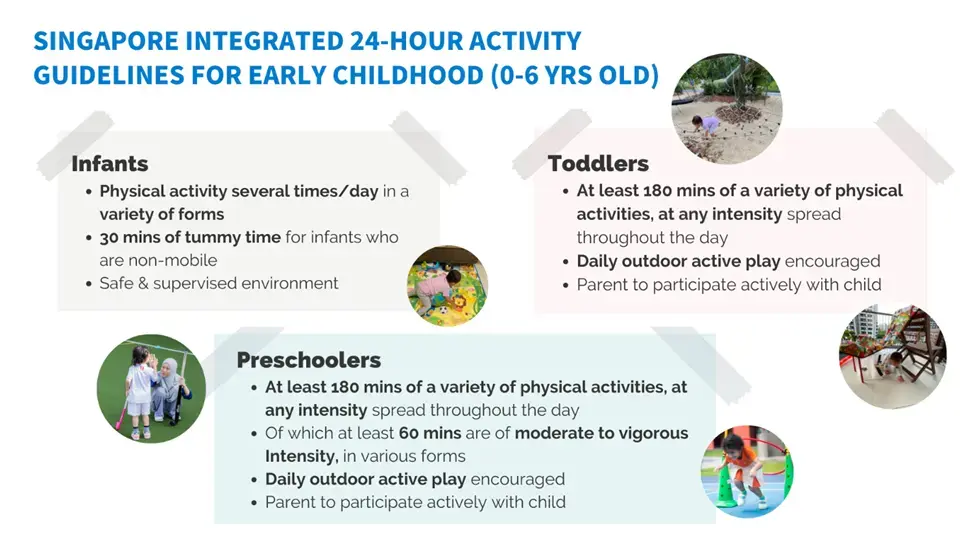
And variety is key. This helps children explore different sports and activities, and develop their motor skills.
Dr Chew said: “Some parents may be very keen for their kid to focus on one particular sport so that they may excel in it. But exposing your child to a variety of different sports is important for their overall motor development, as well as for them to remain interested and continue enjoy doing sports as they grow older; they become more confident and more willing to try out stuff. Otherwise, they may become more afraid to try as they grow older. And when you’re afraid to try out new things, you may resist doing them. Parents should encourage their children to take part in a variety of activities.”
Ms Sim has four daughters aged 7 to 16, whose preferred sports range from yoga to karate, bowling to netball. But one thing gets them all together: inline skating. When she asks if they want to go out skating – everybody immediately agrees. “Finding that common ground is so important,” said Ms Sim.
“And having them know that exercise is a fun activity that we do together as a family. So they know that when it’s exercise, it’s not punishment. For many parents, it’s ‘You’ve got to do it because I’m telling you to do it.’ But for me, it’s ‘We’re going to do it because it’s fun’.
Even household chores - from cleaning the house to doing laundry - can be a form of working out, she pointed out. Doing these together as a family teaches children life skills, while giving them the opportunity to move around.
➤ Click here to watch Parent-Child FUNdamental Movement Exercises
A common question Dr Chew gets from parents is how to ensure that their children are getting enough physical activity without compromising their studies. “Taking breaks to engage in physical activity or to head outdoors shouldn’t be seen as compromising at the expense of studies,” she said.
“Being active is actually important as part of brain development. It helps them have better memory, better attention, and concentration. Being physically active doesn’t mean you’re not helping with your grade,” she said. “Parents have realised that trying to put in breaks or bouts of physical activity throughout the day in the midst of busy study schedules are actually important.”
Dr Chew emphasised that physical activity is important for all aspects of a child’s development as it not only helps with motor development and coordination, but also helps instill social skills and improve the child’s mental health.
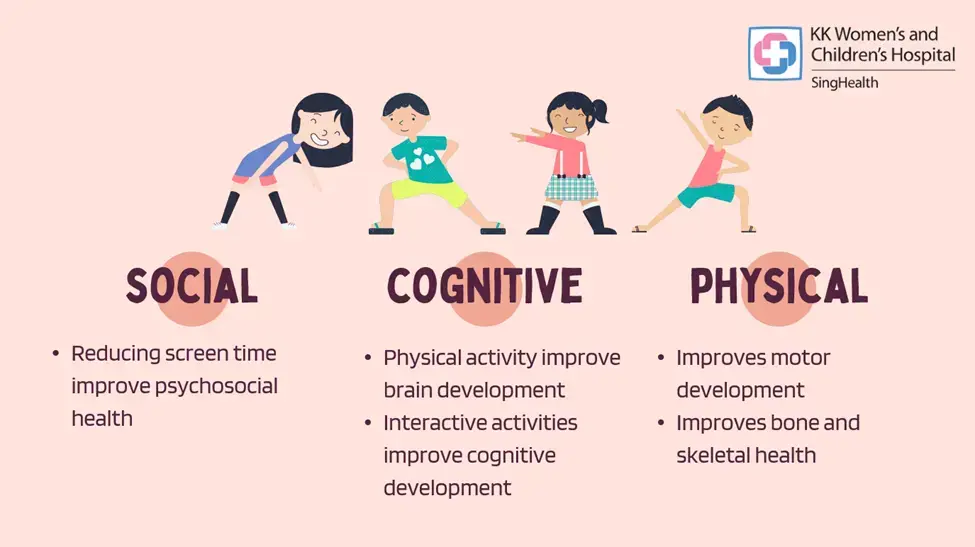
Parents should also make sure that their children have time outdoors, away from their screens. Dr Chew’s advice was: “Engage them in all forms of activities. Get them to be aware of the surroundings. Get them to be outside and socialising instead of just on their phones. These are important aspects in a child’s development, and it aids in their mental wellbeing as well.”
“They also learn to be more resilient, and to have sportsmanship. Those are skills that are important for children and teenagers to acquire. We’ve been seeing increasing mental health issues among youths, so I think one of the most important ways to improve their mental health is to get them to be more physically active, to be out there and to be more social,” said Dr Chew.
”Parents are children’s most important role models when it comes to getting active, and it’s never too late to expose childrens to a variety of activities.” she added.
“Incorporating physical activity into our children’s lives is something parents have to prioritise,” said Ms Lim. “Being active is not a convenience. It’s a must-have!”
➤ Get Tips from Active Health Coach
Learn how to Move Better as a family from our coaches at the Make Every Move Count workshop.
➤ Read More: